Lepidoziaceae
This family contains a group of plants which may appear diverse, but they have similarities in the basic shape of the leaves and underleaves, which are divided into 3 or 4 lobes. The underleaves are smaller than the lateral leaves.
Bazzania - this genus is found world wide. It is often found in large clumps at the bases of trees or on rotten logs.
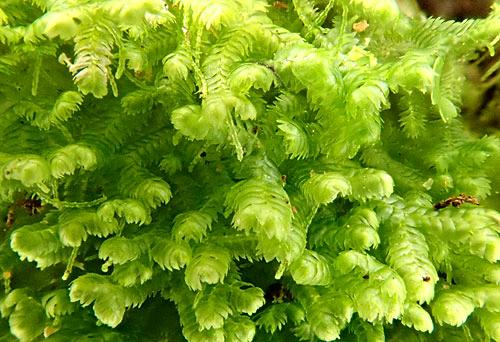
Bazzania adnexa
The most common of New Zealand's Bazzanias.
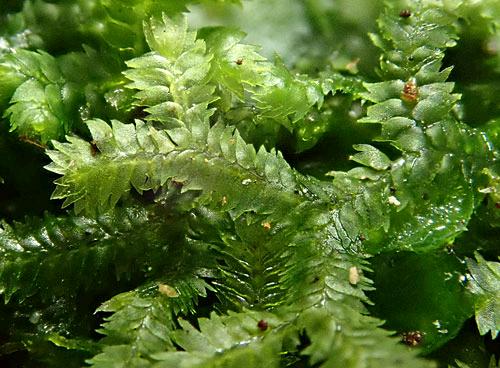
Note the Y - branching of the stems - a feature of the Bazzanias. The individual leaves are about 1.5 mm long.
Bazzania novae-zealandiae
Yes, it is different from the one above - you need a good hand lens to look at the leaf tips and the underleaves.
This is the largest of NZ's Bazzanias.
A sporophyte of Bazzania tayloriana.
Bazzania tayloriana
The most distinctive Bazzania with its pale colour, which in the forest light is a blue-green. The leaves are very small - about 2mm long.
The underleaf, showing three blunt teeth.
Acromastigum colensoanum
This genus may appear to be like a Bazzania, but the leaf never has 3 teeth. Instead it is unequally bifid, as shown in the next three images.
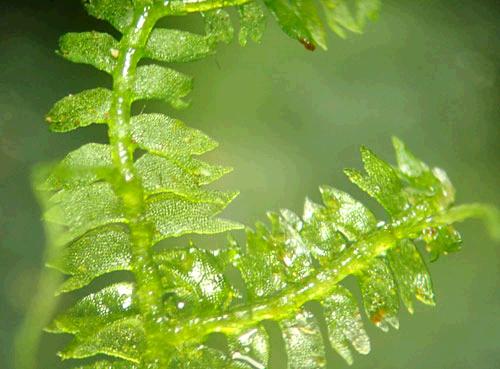
This image and the next one clearly show the unequal bifid teeth at the end of each leaf.
The underside of Bazzania adnexa.